- Like oxen, ministers should be provided for, as they go about their work (1 Corinthians 9:9, 10)
- False Prophets are like dogs that eat their own vomit and pigs that wallow in the mud (2 Peter 2:22)
- We are all like sheep in that we stray and go our own way (Isaiah 53:6) but the saved are like sheep gathered into one flock with Christ as their Shepherd (John 10:14, 28)
- Self Righteous Pharisees are like snakes, devious and sly (Matthew 23:33)
- Those who wait on the Lord, like eagles will soar through the air (Isaiah 40:31)
- As fish are caught in a net so evangelists catch people by drawing them to Christ (Mark 1:17)
- Believers are to be as wise as snakes and as gentle as doves (Matthew 10:16)
- Ants warn us against laziness, giving the good eample of storing up food for the winter (Proverbs 5:6-11)
- There are many lessons to learn from lions including the fact that the devil is like one in that he prowla around looking to pick off an indiivudal to attack (1 Peter 5:8) and tat once dea they are nothing to be afraid of (Ecclesiastes 9:4)
- Goats may well look like sheep but they point to unbeoeivers and when the Shepherd separates the sheep and goats the goats will go away to eternal destruction (Matthew 25:31-33, 41-4
Showing posts with label God's Works. Show all posts
Showing posts with label God's Works. Show all posts
20241023
10 Bible Animals and their Lessons
20241012
The Divine Works 2
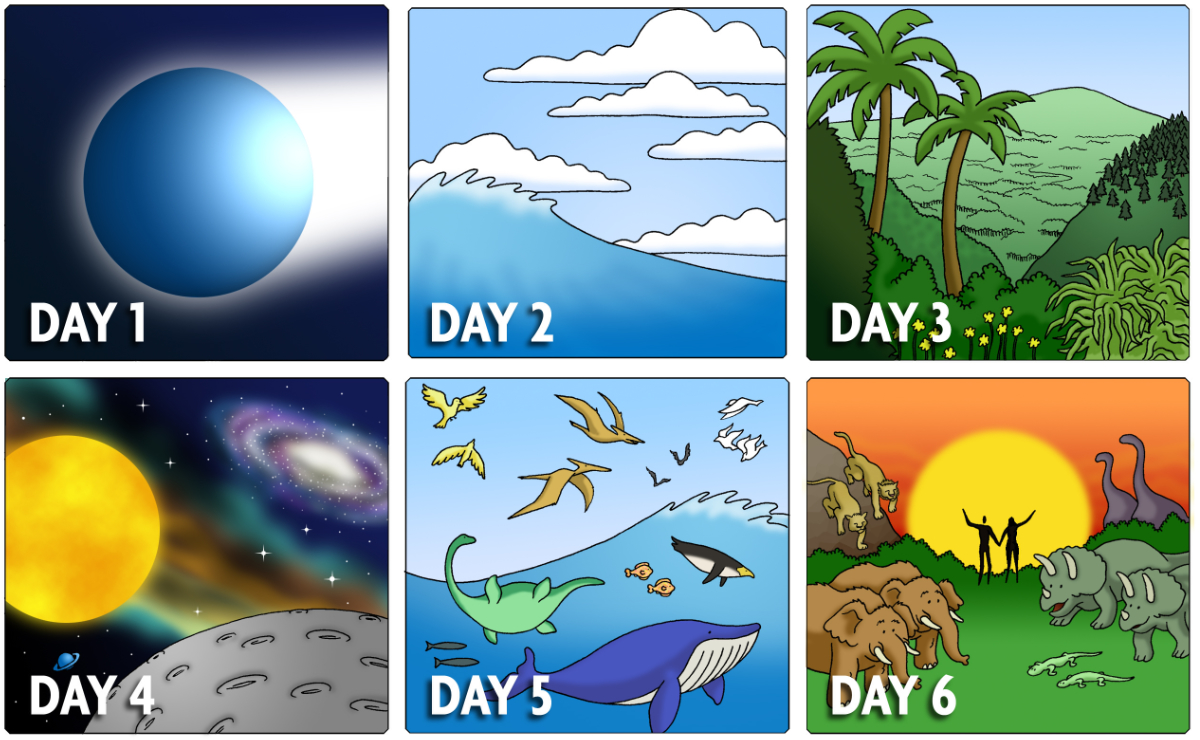
Picking up on the hint from Gearing, one way to meditate on the divine works would be simply to meditate on what God created on the six days of creation. That is
Day one when God created light and dark
Day two when God created the sky
Day three when God created dry land, seas, plants and trees
Day four when God created the sun, moon and stars
Day five when God created creatures that live in the sea and creatures that fly
Day six when God created animals that live on the land and humans, made in the image of God
Day two when God created the sky
Day three when God created dry land, seas, plants and trees
Day four when God created the sun, moon and stars
Day five when God created creatures that live in the sea and creatures that fly
Day six when God created animals that live on the land and humans, made in the image of God
And so one could meditate on
- Day and night and light and dark
- The sky, including its major layers - the troposphere, stratosphere, mesosphere, thermosphere and exosphere.
- The land and the sea and the various plants and trees that grow in and on them. There are various ways of dividing up plants, eg ferns, mosses, gymnosperms and flowering plants or Herbs, Shrubs, Trees, Climbers and Creepers.
- The sun, moon and planets and stars and comets. In our solar system the terrestrial planets we call Mercury, Venus, Eart and Mars, and the giant planets Jupiter, Saturn, Uranus and Neptune.
- Creatures that live in the sea and creatures that fly. As for sea creatures, one can think of sea reptiles, like turtles; fish; sharks and rays; cephalopods, crustaceans and other shellfish; corals and invertebrates; marine mammals, like seals.
- As for birds, examples include Crow, Dove, Sparrow, Woodpecker, Owl, Eagle, Hen, Parrot, Raven, Stork, Swan, Quail, Pelican, Kingfisher.
- Animals that live on the land and human beings, made in the image of God. Land animals include reptiles and many different mammals. These include rodents, such as rats, mice, squirrels and voles; insectivores, such as hedgehogs, moles and shrews; carnivores, such as foxes, badgers, otters, pine martens, stoats, weasels and polecats; lagomorphs, ie rabbits, brown hares and mountain hares; deer, including red deer, fallow deer, roe deer and muntjac; other mammals including bats, etc.
- To think about human beings one can focus on parts such as the eye or the ear or the hand and how God has made them. The fact we are body and soul is fascinating.
20240918
Gearing on meditating on the works of God

In his work on The Mount of holy meditation William Gearing (1625-1690) says
Chap. 8. Of the subject of Meditation. Sect. 1. Of meditation on the works of God.
I now proceed to discusse the subject-matter of meditation; and here I am launching into a great Ocean, but like the dogs of Nilus, I shall but lick and away.
The first subject of meditation is God's works of Creation; a fit matter for our serious meditations: I remember the dayes of old, saith David, I meditate on all thy works, I muse on the work of thy hands, Psal. 145.5. He looketh up to the Heavens, and considereth the work of God's fingers, meditating on all those works that were visible to the eye of man, Psal. 8.3 called elsewhere the work of his hands. Isa. 48.13. My hand hath laid the foundation of the earth, and my right hand hath spanned the Heavens; it is for that they are of such excellency, as if they had been his handywork indeed, which yet were made by his word only, as Moses, and St John do declare, Gen. 1.6. Joh. 1.3. That great advancer of learning hath an excellent passage suitable hereunto. It is to be observed, saith he, that for any thing which appeareth in the History of the Crea∣tion, the confused masse and matter of Heaven and earth was made in a moment, and the order and disposition of that Chaos or mass was the work of six dayes; such a note of difference it pleased God to put upon the works of power, and the works of wisdome: wherewith concurreth, that in the former it is not set down that God said, Let there be Heaven and earth, as it is set down of the works following, but actually, that God made Heaven and earth, the one carrying the stile of a Manufaction, the other of a Law, Decree or Councell. It is not enough that we barely look on the works of God, but we must meditate upon them; for if we do no more than see them, the Oxe, the Bull, and the Horse, do as much as we. If we see nothing in the Heavens, saith a grave Divine, but that they are lightsome, and above our reach, the Horse and Mule see this as well as we; if we see nothing in the earth, but a place to walk in, or to take our rest upon it, the beasts and fouls see this as well as we; if we see nothing in our gorgeous apparell, but the pride of a goodly colour, the Peacock seeth that in his feathers; if in all our refreshment from the creatures we know nothing but the pleasure and sweetnesse of our sense, the Swine hath as great a share herein as we; if hear∣ing, seeing, smelling, tasting, feeling, be all the comfort we can find in the works of God, the dumb creatures have these senses more exquisite than we, and we have turned the hearts of men into the hearts of beasts, who with wisdome and reason can do nothing, and the words of the Prophet are fulfilled in us, Man being in honour understandeth not, and is like the beasts that perish, Psal. 49.20. therefore the sight of God's works must affect us more than so, else shall we be but as the beasts, and follow them.
Now you are to meditate how God brought forth all his works in the space of six dayes, before he finisht them; he did not create the world all at once, but took time for the Creation of it, to teach us to take speciall time duely and orderly to consider and meditate on the works of God: if he that could have made the Heavens and the earth, the Sun, Moon, and Stars, and all crea∣tures, in a moment; yet it pleased him to take time for the creating of them; this should teach us to select some space of time for the meditation of them: we must not think it enough to look up∣on them at one view, but to passe from part to part, from one creature to ano∣ther, and in every creature to admire the workmanship, power, wisdome and goodnesse of the Creatour, as we are taught, Psal. 92.4, 5. Thou Lord hast made me glad through thy works, and I will triumph in the works of thy hands: O Lord how great are thy works, and thy thoughts are very deep: a bruitish man knoweth not, neither doth a fool understand this; which Psalm as the Title tells us, was a meditation penned for the Sabbath day: therefore I say, God would spend six dayes about the Creation of the world, whereas he might have done it in an instant, and in a moment of time, to the end that we might the better meditate upon it from point to point, for which purpose he presently ordained the Sabbath: Thus Job 1:6 tells us, that we must not idly behold the work, but must magnifie the workman; Remember that thou magnifie his work which men behold; this we will do coming into the Shop of an excellent Artizan. The eternall power and Godhead is seen by the things that are made; but most of us have great cause to be ashamed, that we have spent so little time in meditating on the works of God; yea who can truly say, he hath spent so much time in meditating on God's works, as God spent in ma∣king them? How few are there that have set apart so much time ever since they were born, as (if it were all laid together) will make up six dayes one entire week? What a shame is it for man whom God made on purpose to view his works, and by them to glorifie him, not to spend so much time in meditating upon them, as God spent in making of them; therefore we have great cause to become more carefull and studious readers of this great Book of nature for time to come: There is a threefold Book into which a Christian is to make inspection,
The Book of nature, or of the creatures.
The Book of the Scriptures.
The Book of conscience.
The Book of the creatures hath a powerfull conviction; meditate upon it, and observe God's power, or thou art an Atheist.
The Book of the Scriptures hath a power of conversion; meditate on it, and learn the will of God out of it, so to serve him, or thou art an hypocrite.
The Book of conscience hath a pow∣er of accusation; meditate on it, or thou art an Infidel.
The Book of nature hath God spread wide open, and before us, that he that runs may read; Austin calls the world Gods Book in folio; every creature should be to us a page in this Book, and every part of a creature a line in this Book: How carefull should we be to take these things into our thoughts: our Saviour saith, Matth. 24.15. When ye shall see the abomination of desolation (spoken of by Daniel the Prophet) stand in the holy place, who so readeth, let him understand: So say I, let him that readeth in this great Book of nature, understand to what end these creatures were created, even to the end that we might view them, and in them glorifie the Creatour.
And seeing God hath not only acquainted us, in the grosse, what he did in generall, but hath condescended so far, as to tell us, what he did every day; what he did the first day, what he did the second day, &c. I dare boldly affirm, that it were very convenient and expedient every day to set apart some time on that day, to meditate on the works that were created on that day; it is as convenient a method, as any I can imagine, for it is following of God in the Creation this being considered, together with the dulnesse of our apprehensions, and how apt our thoughts are to turn aside to vain and unprofitable objects, the order will be found to be very necessary.
I shall give you a tast of such kinds meditations, from one of the dayes of the week, the first day of the week called the Lord's day: on this day set apart some time to meditate on the works that were on that day created first, the works of the evening, the works of the morning.
1. The works of the evening; as the creating that huge body of the Heavens: when we see that vast body, and how God stretcheth out the Heavens as a curtain; the greatnesse of the Heavens should teach us to meditate on the greatnesse of the infinite Jehovah: if the Heavens do so far exceed our thoughts, how great then is he whom the Heaven of Heavens are not able to contain: if the earth be so glorious (as it is in the spring time) how unspeakably glorious are the Heavens which far exceed the earth; and here we may admire his greatnesse, who was able to set up such a rich canopy and covering over the earth; and here also let us meditate on the unspeakable goodnesse of God to man, that he hath made for man not only a rich dwelling here below, but also provideth for him a dwelling place in the Heavens, there to sit down with him in his Throne, Rev. 3.20. That man that is but dust and ashes, a lump of earth here below, should be exalted to the highest place of the Creation: this should check us or our folly, in suffering the earth to steal away our hearts from God, as if there were no greater happinesse to be had than here below: what stupid creatures are we to spend more time in getting a few white and red pieces of earth, than in getting a glorious possession of the Kingdome of Heaven, for the attainment whereof we should think no time too much, no pains too great, no affections too strong.
Furthermore, bring your meditations to the earth, created on the same day also, that which yeelded matter and stuffe for the making of all creatures here below: consider, that the earth was a formlesse lump before God beautified and adorned it, it was a meer nothing: Painters can draw pictures without colours; Architects raise no buildings without materials and if you take away Marble or Porphiry from Engravers, they can carve neither Images nor Statues. It is only God that actuateth nothing, that formeth being out of a non-entity, as one well saith: the earth receiveth its being, beauty, and all it hath from God.
The meditation hereof should not suffer us to let any thing in the ears to withdraw our hearts from God: sore God made the earth it was nothing; wilt thou set thine eyes upon that which is not? Why should that which is nothing draw away our hearts from God who is full of all perfection; the earth also at first was a confused masse of things, without form, and void: this should draw out from us this meditation; to make us to consider, that we that are of the earth are altogether polluted in sin, lying in our bloud, our souls being all stained with sin, and without any form of holinesse and righteousnesse, yea void of all the saving graces of Gods Spirit: In me, saith Paul, that is in my flesh, there dwelleth no good thing: and as darknesse was then upon the face of the deep, so darknesse is upon the face of our souls; a man may see, hear, read, but can have no true discerning of spirituall things, till the day-Star arise in his heart, for spirituall blindnesse is upon the face of his soul.
Here then is condemned the folly of those that think ignorance the mother of devotion; but while men remain in their naturall blindnesse, they can perform no pleasing service to God; blind services may be acceptable to the Prince of darknesse, but they are abominable to the Father of lights: light was the first thing that God made in the Creation; and when there was light, the earth lay for some dayes dead and senslesse lump, and could not so much as bring forth one grasse or herb, till the Spirit of God moved on the face of the waters: so in a new Creation, when there is no light wrought in the understanding yet canst thou not bring forth one pleasant fruit of holinesse, till the Spirit of God flutter over thee, and by a divine heat and warmth move and stir thy soul, and enable thee to perform acceptable obedience to God.
2. I come to the work of the morning: then he created the light on the first day of the week, commanding the light to shine out of darknesse; now us set apart some time to meditate this excellent creature, the light, which the glory of God is greatly manifest: there was nothing before the utter darknesse; then the Lord creatrd the light without the Sun, in that the power of God is admirable; should greatly wonder at midnight to see a great light to shine forth, and expell the darknesse of the night: this may lead us to this meditation; that as God caused on this first day of the week light to arise, and break out of darknesse; so on this first day of the week also, he caused his own Son the light of the world, to arise out of the grave of darknesse, who shined through many dark thoughts and apprehensions, into the hearts of his disconsolate Disciples; for his own Disciples did then begin to doubt; We trusted, said they, that it had been he which should have redeemed Israel, Luk. 24.21. Here also we may meditate on the excellency of heavenly knowledge; that wisdome excelleth folly, even as light excelleth darknesse: Light is comfortable, and sweet it is to behold the light of the Sun, Eccl. 11.7. Darknesse makes men sad and timerous: so wisdome makes a man's face to shine, but ignorance is uncomfortable: light manifesteth things as they are, but darknesse hides them: light distinguisheth one thing from another, darknesse confounds things all alike: so knowledge gives us a right discerning of things, but ignorance overwhelms us with horrour and amazement: light directs a man in his way, but darknesse misguids him: so wisdome shews us the true way, whereas the ignorant wander in by-paths, and fall into the bottomlesse pit.
I shall conclude this Section, with that meditation of Austin, Heaven and earth, saith he, and all things therein contained, do make a continuall cry round about me, that I should love thee; O Lord they shew thy worthynesse, and declare thy bounty; such a world; such Heavens; such an Ocean; such an earth; such earthly creatures; insensible; sensible, reasonable; and all wonderfully framed Lord how mighty, how wonderfull, how wise art thou that madest them, and therefore worthy our love; and being thus made thus to blesse, to continue, to encrease, to multiply them: yea more, to fill us with them; and therefore thy bounty, thy super abundant bounty must needs make us to love thee.
20211111
Piper on meditating on the works of God
This passage on pages 229 and 230 of John Piper's Providence
Our Joy in Creation Is Finally Joy in the Lord
Return with me now to Psalm 104, where I said we could see clearly the purpose of God to make the world a theater for his glory for the enjoyment of his people:
O Lord, how manifold are your works! In wisdom have you made them all. (Ps. 104:24)May the glory of the Lord endure forever. . . . I will sing to the Lord as long as I live; I will sing praise to my God while I have being. May my meditation be pleasing to him, for I rejoice in the Lord. (Ps. 104:31, 33–34)
The psalmist calls his psalm a “meditation” (or meditative praise: “May my meditation be pleasing to him”). He has been meditating on the world God creates and sustains and governs. The world of providence. What he has seen moved him to exult in God’s unparalleled wisdom in the countless natural wonders God creates and controls. “In wisdom have you made them all.” The glory of this wisdom, and its execution in power and goodness, causes the psalmist to sing and praise and rejoice in the Lord.
This is crucial to note: he rejoices “in the Lord” (104:34). Yes, he rejoices in the works of the Lord (as God himself does, 104:31). It would be an ungrateful sin not to. They are gifts and blessings. But when all is said and done and the psalmist hopes his meditation will be pleasing to God, the ground of his hope is this: “For I rejoice in the Lord” - not finally or fully in his works, but in himself. That is what creation is for. All of creation - in the skies above and on the earth beneath - is designed to reveal the glory of God. His glory, including his power, his divine nature, his understanding, his goodness - all these and more - is put on display in the theater of God’s glory called the natural world:
The heavens declare the glory of God, and the sky above proclaims his handiwork. (Ps. 19:1)
[God’s] invisible attributes, namely, his eternal power and divine nature, have been clearly perceived, ever since the creation of the world, in the things that have been made. (Rom. 1:20)
The Lord is the everlasting God, the Creator of the ends of the earth. He does not faint or grow weary; his understanding is unsearchable. (Isa. 40:28)
The Lord is good to all, and his mercy is over all that he has made. (Ps. 145:9)
20211108
Sermon The Works of God (9)

At the moment we are in a series looking at things to meditate on. We've been saying that if we profess to be Christians that implies certain obligations on our part.
- Christians pray. Devote yourselves to prayer, Paul says (Colossians 4:2).
- Christians read their Bibles. Psalm 1 says the blessed person delights in the law of the Lord
- Christians also meditate on God and his Word, as Psalm 1 says, day and night.
To help us in this we are suggesting subjects that you can usefully meditate on. So far we've looked at four subjects - God's nature and attributes, the states of Christ (his humiliation and exaltation), human nature ion its fourfold state and the four last things (death, judgement, heaven and hell).
In the list I am working from the Puritan George Swinnock also mentions the offices of Christ (His being prophet, priest and king) the vanity of the creature, the sinfulness of sin, the love and fullness of the Saviour. Then at the end of his list he has the divine Word and the divine works.
A great deal of our time meditating will be spent simply meditating on a verse or several verses of Scripture. You take a verse, say John 3:16 For God so loved the world that he gave his one and only Son, that whoever believes in him shall not perish but have eternal life. You think of the fact the sentence begins with God - where we must always begin. It speaks of God's love (God so loved). It is always good to meditate on God's love. When it comes to world you'll have to decide what it means in that context - obviously not the planet, probably not all the people in it, either. Probably the world in the sense of its wickedness and lostness. God so loved the world that he gave - he did something about it. He gave his one and only Son ... and so on.
Besides meditating on God's Word, we should meditate on his works. This can be a little more difficult to get to but there are lots of resources for us. So for example, have you ever sat and thought about water? Perhaps not but it is worth doing.
Let me quote from part of an article I found on water.
... Water might not immediately come to mind when we think of God's good gifts to us. But it is so well designed for our use that a simple glass of water should make us aware of the fingerprint of the Creator and give him glory.
Water is not only essential to life on earth, but also incredibly useful. We drink it, cook with it, bathe in it, clean with it, play in it (or on it in colder times) ... Water regulates earth’s temperature, provides a habitat for the seafood we eat and is essential for growing all of our food. And those are only a few of water’s uses!
Water is colourless and tasteless, making it perfect for cooking. If it had a flavour or even a colour, certain foods would be made much less appetising. Research has even shown our bodies may be able to taste tasteless water, alerting us if we are drinking something that looks like water but is not actually water. Water in its pure state has a neutral pH (not an acid or alkali), again making it perfect for cooking and drinking.
Water is ideal for transporting dissolved substances, such as minerals, nutrients and waste, throughout (or out of) our bodies.
Water is one of few liquids that expand when frozen, allowing it to float on liquid water. If water sank when it froze, aquatic life in colder climates would be impossible.
Water molecules stick to each other, creating surface tension. Surface tension allows insects to walk on water, makes rain fall in droplets, allows particles to float in water and keeps water from immediately evaporating.
... Water was one of God’s first creations. Genesis 1:1, 2 says God created the heavens and earth and initially the earth was covered in water. As 2 Peter emphasises, the earth was formed out of water and through water (2 Pet 3:5). On day two, this water was separated so some remains on earth and some is spread throughout the heavens ....
I'm sure you could do that with other subjects such as air and fire and so on. What I thought we could usefully do this morning is to consider some of the animals God has created. Probably the best way to do that is to go to Scripture and some of the passages that mention animals and direct our meditation in that way. I want us to look at four places
1. Learn from the various animals mentioned in the closing chapters of Job
So first let's go to the closing chapters of Job, chapters 38-40, where a number of creatures are mentioned. The reason they are mentioned, along with things like snow and ice, rain and hail, the stars and the sea, is to underline the simple truth that God is in control and that if we wish to challenge the way he runs this world then we need to get some education first. There is a whole lot going on in this world that we know very little about.
The references to animals begin at the end of Chapter 38 (39-41) where God asks the question
Do you hunt the prey for the lioness and satisfy the hunger of the lions when they crouch in their dens or lie in wait in a thicket? Who provides food for the raven when its young cry out to God and wander about for lack of food? Now we have a tremendous advantage over Job I guess in that we know what is being spoken about here. We have seen documentaries that show lions hunting or ravens feeding their young. When we see such footage we ought to remember that it is God who created all these creatures and who cares for them all in the wild. He is in absolute control.
The passage goes on to speak about mountain goats, wild donkeys, the wild oxen, ostriches, horses and birds of prey like hawks and eagles. Job has to put his hand over his mouth and humble himself. What does he know?
And then it starts up again. God speaks this time about the Behemoth, a land creature, and at length, the Leviathan, a sea creature. The writer has a lot of fun. He says of the Leviathan (41:4) Can you make a pet of it like a bird or put it on a leash for the young women in your house? We are not sure what these creatures are. Are they creatures still around today like a hippo and a whale or are they extinct creatures like dragons and dinosaurs? Whatever they are, the point still stands - God has made these magnificent creatures and he sustains them and every time we see or think about such creatures we ought to acknowledge the greatness and power of God.
2. Learn from some lions and a great fish in the Books of Daniel and Jonah
Understandably, the stories of Daniel in the lions den and Jonah in the belly of the great fish are among the most famous in the Old Testament. In Daniel 6 Daniel as an old man becomes the third highest in the Persian kingdom under Darius. Due to the envy of his enemies he ends up, despite all Darius can do, as you know, being thrown into a den of lions, which were kept for amusement and as an occasional means of punishing offenders.
You are well aware that lions are dangerous creatures. Every few weeks or so you can read about people being attacked and often killed by lions. $ For example the other day 22 year old Alexandra Black was killed by a lion in a Conservation Centre in Indiana when an enclosure was being cleaned. She had a degree in animal behaviour and had started working as an intern at the centre two weeks before. Attempts to tranquilise the animal failed so it was shot dead. It's unclear how it escaped the area that was supposed to be locked.
Now what happens in Daniel's case is that though he is lowered into the very den where these lions are kept he spends a whole night there unharmed. It is wonderful to read what happened the next morning (Daniel 6:19-23) At the first light of dawn, the king got up and hurried to the lions' den. When he came near the den, he called to Daniel in an anguished voice, Daniel, servant of the living God, has your God, whom you serve continually, been able to rescue you from the lions? Daniel answered, May the king live forever! My God sent his angel, and he shut the mouths of the lions. They have not hurt me, because I was found innocent in his sight. Nor have I ever done any wrong before you, Your Majesty. The king was overjoyed and gave orders to lift Daniel out of the den. And when Daniel was lifted from the den, no wound was found on him, and don't miss this because he had trusted in his God. This is a dangerous fallen world but we will be safe if we trust in the Lord. When Daniel's false accusers and their families are thrown into the same den (24), strikingly before they reached the floor of the den, the lions overpowered them and crushed all their bones.
The story of Jonah is similar in some ways, except in this story Jonah is actually swallowed by a great sea creature but he prays from the very belly of the fish and is miraculously vomited out alive.
Plenty of people say it didn't happen, of course, and it is not something we can be sure has happened since. There are lots of stories but none seem to be authentic. There are sea creatures that could swallow a man whole - a sperm whale or white shark for example - the problem is surviving once in there. It is likely that Jonah was bleached by the stomach juices. If we believe this is God's Word there is no need to doubt the truth of the story. Like the story of Daniel it is a story of the power of faith, the goodness of God and the fact that he is a God who can raise us from the dead.
3. Learn from the various animals mentioned in Proverbs 30
Proverbs 30 is by a man called Agur son of Jakeh. Chapter 30 refers to some 12 different creatures as Agur endeavours to drive home various points. Let's think about these different animals then.
1. Learn from the leech about insatiable things. 15, 16 The leech has two daughters. 'Give! Give!' they cry. There are three things that are never satisfied, four that never say, 'Enough!': the grave, the barren womb, land, which is never satisfied with water, and fire, which never says, 'Enough!'
So we begin with the humble leech. As you know, the outstanding feature of leeches is that they are bloodsuckers. It sounds horrible but we should be thankful for them. The medical profession still use them - for example to improve blood circulation. The leech's insatiable desire for blood is a pointer to four other things - the grave, the barren womb, land in time of drought and fire.
There never comes a point where the grave says ‘Okay, enough people have died’. Death goes on and on and will until Christ returns.
It is a terrible thing for woman to want children and yet not be able to. It is not good saying to such a woman ‘Well you’ve been trying for a few years now. Best give up on it.’ No, while there is a possibility of bearing children she will long for it. Pray for such people.
Think also of how drought, on one hand, can devastate a country and of how fires can do such damage. Again it stirs us to pray.
The leech gives us insights then. Beware of your passions and ambitions. They can be powerful things. Look to Lord and his will, rather.
2. Learn from the vultures and ravens about obeying your parents. Verse 17 seems a strange proverb The eye that mocks a father, that scorns an aged mother, will be pecked out by the ravens of the valley, will be eaten by the vultures.
It is from a desert culture where a child is warned by its parents not to wander off. Once or twice the child disobediently wanders, however, but thankfully is found again unharmed. Again it is reminded to obey its parents. But then it strays again. This time there is no happy ending. It is only some time later that the child is found its eyes pecked out by ravens, its little body eaten by vultures.
3. Learn from eagles and snakes about what happens when difficult things become easy. 18-20 There are three things that are too amazing for me, four that I do not understand: the way of an eagle in the sky, the way of a snake on a rock, the way of a ship on the high seas, and the way of a man with a young woman. This is the way of an adulterous woman: She eats and wipes her mouth and says, 'I've done nothing wrong.'
First we are reminded of some amazing, incomprehensible things. The first two concern animals
The way an eagle flies through the sky. They do it with amazing ease. Not like us at all.
The way a snake moves across rough rock. Snakes have no legs but can quickly move along even on rough ground. How different we are - barefoot on a pebble beach for example.
He also mentions a ship far from port - out on the high seas. What a majestic sight - a ship sailing on the sea. The last reference is either the act of wooing or the actual mysterious act of love.
Some see the point of comparison in the fact no trace is left in each case. Rather the point is that these mysterious things seem hard, almost impossible - flying, moving smoothly over rock, riding the waves, a man seducing a maiden - but happen. In verse 5 we see the adulteress who sees the act of adultery as like having a meal. You think that a terrible thing, I trust. How can she live with herself? For her sex is no big deal. Yes, the first time perhaps it was something (like the first time you see an eagle fly, a snake on a rock) but no longer. Her conscience is seared. What about you? Are you so used to certain sins, you think nothing of them? What a danger! Recognise it. Repent!
4. Learn from from four small creatures about using resources wisely. (Skipping over verses 21-23) 24-28 Four things on earth are small, yet they are extremely wise: Ants are creatures of little strength, yet they store up their food in the summer; hyraxes are creatures of little power, yet they make their home in the crags; locusts have no king, yet they advance together in ranks; a lizard can be caught with the hand, yet it is found in kings' palaces.
Four small creatures that are wise in certain respects
Ants - small insects that work hard all summer building up stores of food for winter. (There is a longer section on the ant as an example in Chapter 6)
Hyraxes (or some other small creature like a rabbit). For protection these creatures wisely hide in holes in the rocks, safe from predators.
Locusts - Larger than most ants but still small. Together they cause large scale devastation.
Lizards - If you've lived in hot climates you know how you see them in people's houses.
In each case the stress is on the animal's limited size then on the wise way they overcome that disadvantage. Creatures with little strength or power, with no king and that are easily caught make preparations for winter, hide in the crags, advance in ranks and are found in palaces.
We should praise God for these different creatures he has made and learn not to despise the weak. We too are weak and must learn to make the most of our circumstances. Out limitations must not be an excuse for doing nothing. Rather, prepare for judgement day; hide in the Rock who is Christ; unite with other believers and despite your weakness be bold to believe you may enter the palace of the Great King by grace.
5. Learn from four other creatures about true dignity. 29-31 There are three things that are stately in their stride, four that move with stately bearing: a lion, mighty among beasts, who retreats before nothing; a strutting cockerel, a he-goat, and a king secure against revolt.
Here we have three stately animals - a fearless lion, a strutting cockerel, a he-goat - and a king with his army. Nothing is spelled out but it is likely that Agur is getting us to think about the nature and variety of dignity. We need to recognise where true dignity lies - not in our own bravery, our clothing, our uniqueness or our strength. Rather true human dignity is in being made in the image of God. That image is recreated when we trust in Christ.
4. Learn from the four animals mentioned by Jesus in Matthew 10:16
To finish, let's meditate a short while on Matthew 10:16. There Jesus is about to send out his disciples on mission and he says I am sending you out like sheep among wolves. Therefore be as shrewd as snakes and as innocent as doves.
So in one short sentence Jesus mentions four animals for us to think about, when it comes to evangelism. In each case it is only one characteristic of the animal that is in mind and if you want to understand what Jesus is saying you need to get that right. If you decided that the thing about sheep was that they produce wool, about wolves that they are nocturnal, snakes that they are found on the ground and doves that they are white, you would not learn much. In fact with the latter two Jesus spells out that is the shrewdness of snakes he has in mind and the innocence of doves. As for sheep and wolves, in that context they are marked by ferociousness and vulnerability.
And so we say we must go out and tell people about Jesus but we are vulnerable people going out among wolves who can easily undermine what we say and do us spiritual or even physical harm if we do not take care. I remember talking to a fellow student when I was in college who had come full of enthusiasm to tell people about Jesus. For him that meant getting involved in student life - drinking and dancing and so on. What he was finding, however, was that not only was it not going very well in that he wasn't winning others over but he was getting more and more worldly. He was forgetting that he was a sheep among wolves, who were baying for his blood.
With that is the call to be as shrewd as a snake and as innocent as a dove. We need to carefully think through how we can best win people. When a fisherman goes fishing, he will make sure that he has the right bait for catching the sort of fish he is after. We too have to do similar thinking. At the same time we need to be innocent, not trying to take advantage of people or trick them.
A few years ago I was in a research centre in South Wales. I thought I recognised the man in charge there. He was a friend of a good Christian friend of mine. We got chatting and he remembered coming to our church one Friday night to see a film. The film was called To Russia with love and he had been led to believe it was some sort of spy film. In fact it was a Christian film about the gospel in Russia. Misleading this man, boy as he was then, was certainly shrewd but it lacked innocency and so it utterly failed. It simply left a bitter taste and so the man was no nearer to becoming a Christian by it.
20201230
The Divine Works 1

(Based on an article on the Answers in Genesis Website)
Water
Of course, the best fluid to sip all day is water - and lots of it. We are composed of about 60% water and cannot survive more than a week without drinking it.
Water: The Multi-Purpose Liquid
Of course, the best fluid to sip all day is water - and lots of it. We are composed of about 60% water and cannot survive more than a week without drinking it.
Water might not immediately come to mind when we think of God's good gifts to us. But it is so well designed for our use that a simple glass of water should make us aware of the fingerprint of the Creator and give him glory.
Water is not only essential to life on earth, but also incredibly useful. We drink it, cook with it, bathe in it, clean with it, play in it (or or on it in colder times), find beauty in it, travel on it and get energy from its movement. Water regulates earth’s temperature, provides a habitat for the seafood we eat and is essential for growing all of our food. And those are only a few of water’s uses!
Water is perfectly designed for all of these functions
Water is colourless and tasteless, making it perfect for cooking. If it had a flavour or even a color, certain foods would be made much less appetising. Research has even shown our bodies may be able to taste tasteless water, alerting us if we are drinking something that looks like water but is not actually water. Water in its pure state has a neutral pH (not an acid or alkali), again making it perfect for cooking and drinking.
Water is ideal for transporting dissolved substances, such as minerals, nutrients and waste, throughout (or out of) our bodies.
Water is one of few liquids that expand when frozen, allowing it to float on liquid water. If water sank when it froze, aquatic life in colder climates would be impossible.
Water molecules stick to each other, creating surface tension. Surface tension allows insects to walk on water, makes rain fall in droplets, allows particles to float in water and keeps water from immediately evaporating.
Water absorbs colours in the red part of the spectrum (red, yellow, orange), while the blue parts of the spectrum are scattered, giving the ocean and other bodies of water a blue colour. As the light direction changes, translucence and reflection from the surface give a pleasing effect.
Where Did Water Come From?
This incredible molecule covers 70% of earth’s surface and is even found in and possibly even under the mantle. But where did it come from? Evolution always wants to go back to the big bang. Evolutionists believe the big bang created hydrogen and helium. Stars soon formed from these gasses and created oxygen and other elements. Eventually the stars exploded as supernovae, expelling oxygen and hydrogen into space where the two elements formed water.
There are apparently two major competing evolutionary stories on how water got to earth. Some say conditions on early earth would have evaporated any water as earth coalesced and so water would need to be delivered from an outside source, by comets or asteroids. Comets and asteroids would also have delivered material to earth, yet research suggests the asteroids that most likely would have delivered our water aren’t of the right composition to match the material they would have left behind. Also, using evolutionary assumptions about the age of the earth, it appears the earth’s oldest materials crystallised in the presence of liquid water over 4 billion years ago, too old to have been brought by comets or asteroids. To make matters worse for this idea, new evidence suggests water would have been vapourised as it arrived by extraterrestrial delivery.
The other hypothesis suggests maybe water has always been present and volcanoes have delivered it to the surface by degassing, as water vapour is released from cooling magma near the surface. This puts water deep inside the earth from its beginning. This hypothesis runs into the earlier mentioned problem: would the proposed conditions on early earth have allowed such vast quantities of water to remain?
The True Origin of Water
Neither of these proposed solutions adequately explains where water came from or how it could be so perfectly suited for life and for our use. But the Bible gives the answer. Water was one of God’s first creations. Genesis 1:1–2 says God created the heavens and earth and initially the earth was covered in water. As 2 Peter emphasises, the earth was formed out of water and through water (2 Peter 3:5). On day two, this water was separated so some remains on earth and some is spread throughout the heavens, including in comets and asteroids.
Water doesn’t have a mysterious naturalistic origin. It was created by God from the very beginning!
Subscribe to:
Posts (Atom)